How your assistant thinks
The one picture behind every page of these docs: a mind that is rented, a memory that is yours, and senses you add one at a time.
I set up every assistant this way, mine included, and the reason it works is not clever. Once you can see the three parts, most of the questions people ask me in the first month answer themselves: why it forgot something, why it got sharper after a week, why "I'm not technical" turns out not to matter.
Three parts, not one#
Your assistant is three things working together.
- A mind. That is Claude, the part that reads, reasons and writes. You rent it. You do not train it, tune it or program it, and it is the same mind everyone else rents.
- A memory. Your brain: a folder of linked pages on your own mineral, holding everything it knows about you and your work. These docs call it the brain because that is what the app calls it, but in this picture it is the memory, and it is yours.
- A set of senses. The services it is connected to: your mail, your calendar, your task list, whatever else you open a door to.
Why cut it up like this? Because it tells you where the usefulness comes from, and where it does not.
A mind with no memory is clever and forgetful. It can hold a fine conversation, then lose you completely the moment the window closes. You would be introducing yourself every morning. A mind with no senses can only talk. It can draft a good reply to a supplier, but it cannot see that the supplier wrote, or that the invoice they mention arrived on Tuesday. A very sharp colleague in a room with no phone.
So the whole game is two verbs: grow the memory, and add senses. The mind barely changes from one month to the next. What changes is how much it knows about you and how much of your world it can reach.
The memory is yours, and the thinking is rented#
I want to be plain about this because it is the part people find hardest to believe. You never need to know how any of this is built. Your job is to say what you want, in ordinary sentences, the way you would brief a capable new hire on their first week. The mind works out the how.
What you do own, completely, is the memory. It is markdown files in a private GitHub repository that belongs to you, organised in eight layers: north star, philosophy, self, network, past, goals, tasks, and workflow. Open any page on the Brain page and you are reading the same file your assistant reads. Rewrite it and the assistant reads the rewrite. Take the folder somewhere else and the knowledge goes with you.
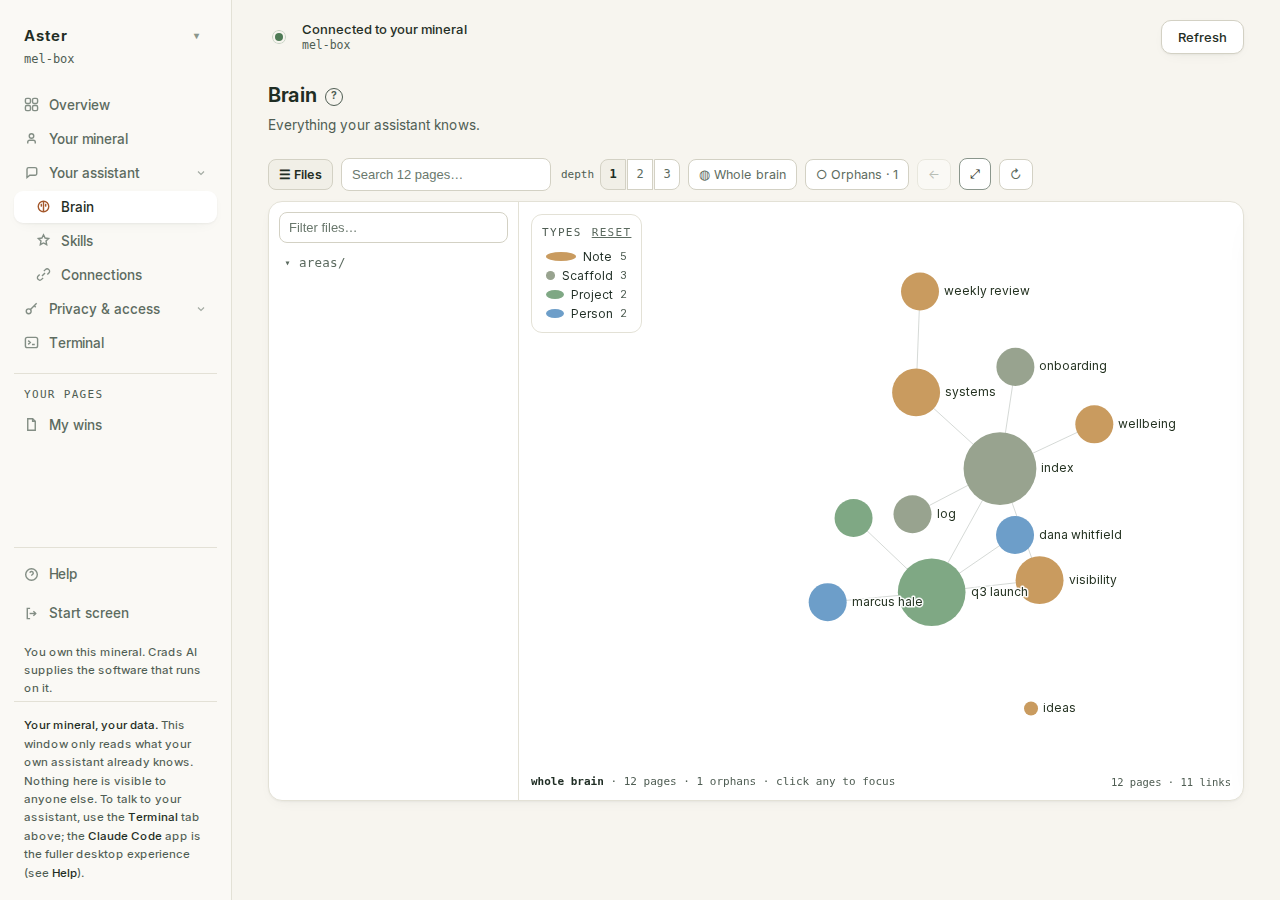
That ownership is the reason I stopped hosting anything for anyone. What a mineral is says why a box each; this page is about what lives in it.
Two kinds of memory#
The single most common confusion in the first month is mixing these up, so here they are side by side.
The conversation is the session you are in right now in the Terminal. Everything said in it is fresh and in view. It has two limits. It has a ceiling: there is only so much it can hold at once. And when the session ends, it is gone. Sessions on your mineral do not resume; a new Open is a new session, and yesterday's conversation is not in the room unless somebody wrote it down.
The brain is permanent. It is there at the start of every session, automatically, before you have typed anything. When your assistant knows that the physio clinic's biggest referrer hates being chased on Mondays, or that the garden-design studio's day rate went up in March, that knowledge lives in a page, not in any one chat.
Once you see those two boxes, a lot of vocabulary collapses into one idea: everything worth keeping moves from the short-term box into the permanent one. /capture at the end of a session writes down what that conversation decided. Pasting a document into the Terminal and asking for a page brings an outside source in. Both end in the same place. There is no hidden third thing, and grow the brain is the whole practice of it.
If your assistant seems to have forgotten something important, it was almost always said in a conversation and never written into a page. Say "capture that" and it moves across.
Context is the whole advantage#
Everyone rents the same minds. If the mind were the advantage, nobody would have one. What makes your assistant yours is the context you wrap around it: the pages, the connections, the skills, the standing instructions about how you like things done. Andrej Karpathy's name for the practice is context engineering, and the shape he describes, a folder of plain pages an assistant reads, writes into and links together, is exactly what a brain is; the credit and the reading are in where these ideas come from.
The practical consequence is a habit. Every time the assistant gets something wrong about you, treat it as a page that is missing or thin, not as a fault in the mind. "It keeps leading the brief with routine invoices" means the goals page does not yet say what matters this quarter. Fix the page and the mistake stops recurring, in every future session, without you repeating yourself.
The four things you can grow#
The four Cs are Nate Herk's framing, and I use it because it maps almost exactly onto the four tabs in the app; credit in where these ideas come from.
| The C | In the app | What growing it looks like |
|---|---|---|
| Context | Brain | the interview, then corrections, then /capture after real sessions |
| Connections | Connections | one door at a time, from what you can connect; Google and Telegram first for most people |
| Capabilities | Skills | the eleven built in, then the ones you write yourself (write your own skill) |
| Cadence | the schedule switch on each skill | what runs without you asking, delivered to Telegram if you tick it |
Every schedule ships switched off. That is deliberate: the order I recommend is read first, draft second, schedule third, and what it will not do is the honest version of the boundaries. The interview is the fastest way to grow context, and the CRIT method explains why an assistant asking you questions beats you trying to write everything down.
What a day of this feels like#
The morning brief reads the goals page you corrected last week. A draft reply lands closer to your voice because you edited the last three and said so, which is what teach it your voice covers. A decision from a call goes into a page in ten seconds and shapes tomorrow's brief. None of that required a setting. It required the memory growing, one page at a time, and a day with your assistant walks through it hour by hour.
A normal tool is the same on day one hundred as on day one. This one has been accumulating a hundred days of you. The early weeks feel like setup. Then one morning the brief names the thing you had not told anyone else yet, because you told it, and it wrote it down.